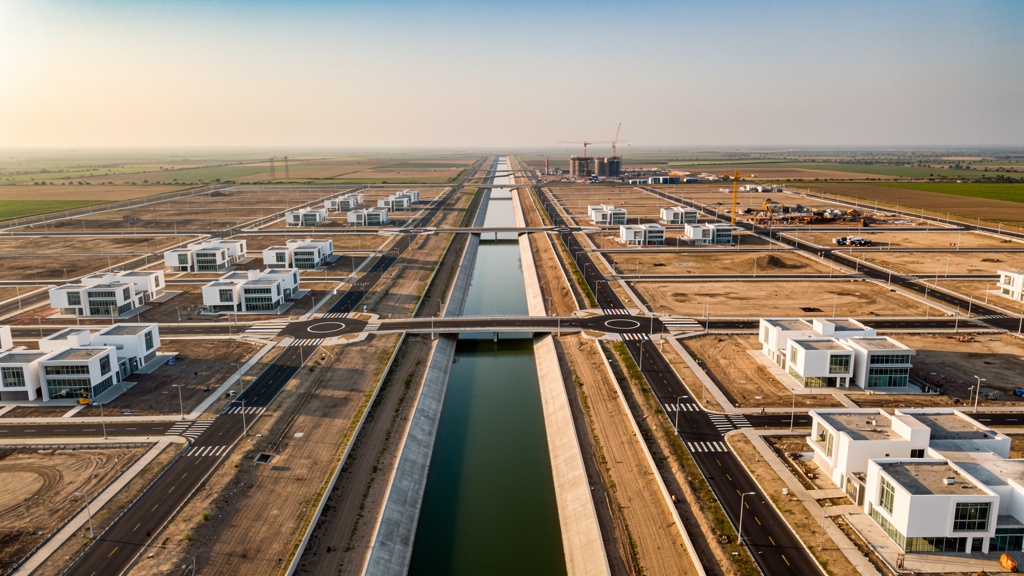
From trading port to greenfield smart city
Long before it became a byword for smart-city planning, Dholera was a modest cotton port on the Gulf of Khambhat, with a trading history and a small Swaminarayan temple at its heart. Today the name carries two very different stories: the historic town, and the vast Dholera Special Investment Region (DSIR) rising beside it.
Dholera is India's first major greenfield industrial smart city — a Special Investment Region spanning roughly 920 km², nearly twice the size of Mumbai island, about 100 km southwest of Ahmedabad. It is a flagship node of the Delhi–Mumbai Industrial Corridor (DMIC).
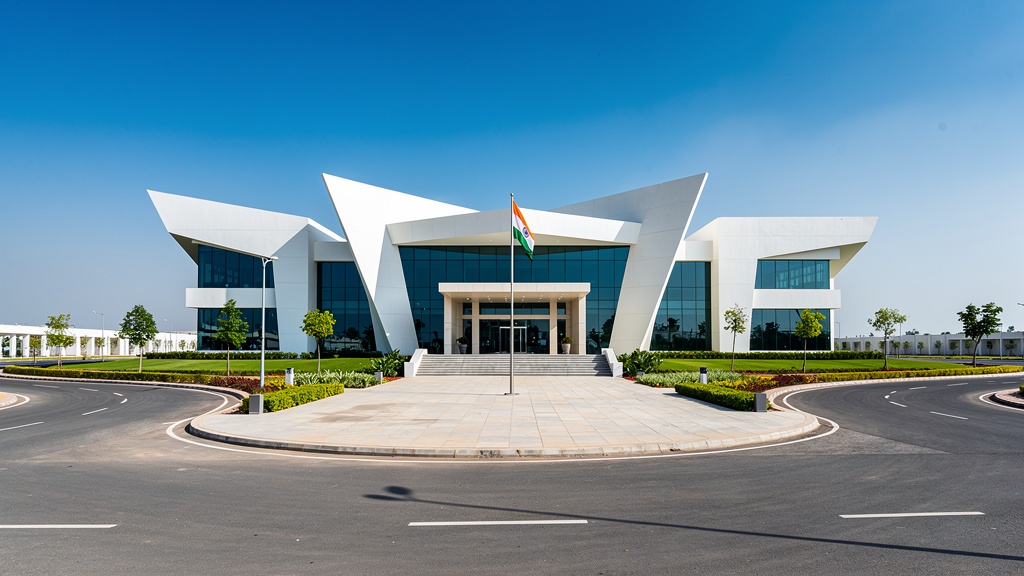
The SIR vision
The DSIR is designed around "smart" principles from the ground up: a planned grid of wide roads, dedicated utility corridors, an intelligent traffic and utility management backbone, and a green belt threaded along the Canal Front. The first phase of development is the Activation Area, roughly 22.5 km², where the earliest buildings — including the ABCD Building and early residential and industrial plots — are taking shape.
For a visitor, the point is not the brochures. It is the scale: standing at an empty intersection with a road that runs straight to the horizon, watching cranes, and realising you are seeing the first pages of a city that will take decades to finish.
An honest status check (mid-2026)
We keep this guide realistic. As of mid-2026:
- The Ahmedabad–Dholera Expressway (NE-8) is operational — about 45 minutes from Ahmedabad.
- The Dholera International Airport is in advanced construction with trial activity; operations are targeted in the coming months.
- The Canal Front recreation zone and the ABCD Building (with its Experience Zone and City Integrated Operations Centre) are the main visitor touchpoints.
- Hotels, restaurants and public access to most industrial zones remain limited and developing. Restricted access to major construction sites — such as the Tata semiconductor plant — is normal and should be expected.
- Plans for a Tent City, food courts and more residential and hospitality facilities are moving fast, so check the Updates page before you travel.
Not to be confused with Dholavira
Dholera (smart city, this guide) and Dholavira (the UNESCO-listed Harappan site in Kutch, ~300 km away) are often mixed up. They are completely different places. See the full comparison →
The old town
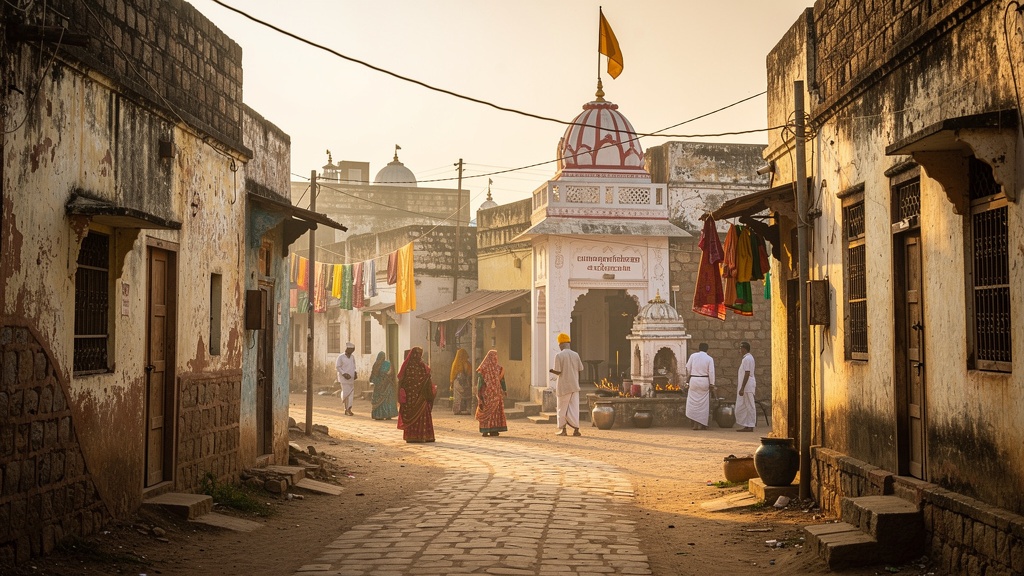
If you have time, wander the historic town. It is not a polished heritage destination, but its lanes, old houses and the Swaminarayan temple give a human scale to the story — the settlement that existed long before the SIR, and the villages that now form part of it.
Respect the villages that are part of the SIR. This is someone's home and livelihood, and the smart city is being built around real communities, not in a vacuum.
Why visit at all?
Because it is genuinely unusual. Where else can you stand in a 4,500-year-old dockyard in the morning and on the empty boulevard of a 21st-century smart city in the afternoon? That ancient-modern pairing — Lothal and Dholera — is the heart of this guide.
Ready to see it for yourself?
Here's what to do and where to go once you're there.
Things to do in Dholera